The AI Search Revolution: How Google's New AI Mode is Reshaping Digital Discovery and Brand Strategy

Google has launched its most transformative search interface update in over a decade with the introduction of "AI Mode", a revolutionary feature that fundamentally changes how users discover and consume information online. Currently in limited deployment across the United States, this innovation signals a seismic shift from traditional search results to AI powered, conversational experiences that could redefine digital marketing as we know it.
For businesses and marketing professionals worldwide, AI Mode isn't just another algorithm update to navigate; it is a complete paradigm shift that demands a fundamental rethinking of search strategy, content creation and performance measurement.
Executive Summary: Critical Insights for Business Owners
- AI Mode fundamentally transforms content discovery, moving from link based results to synthesised, conversational answers
- Traditional metrics become obsolete; brands must evolve beyond traffic and clicks to measure impressions, brand authority and AI answer inclusion
- Content ranking matters less than content trust; information must be comprehensive, well structured and authoritative to be selected by AI
- Paid search evolves from keywords to intent; targeting shifts toward behavioural patterns and audience modelling
- Search volume loses relevance; understanding user intent and question patterns becomes paramount
- Cross platform optimisation is essential; content must serve Google, ChatGPT, Perplexity, Claude and emerging AI platforms simultaneously
The Strategic Context: Why Google is Transforming Search Now
Google's rollout of AI Mode isn't merely an innovation exercise; it is a strategic response to an existential threat. The emergence of ChatGPT, Claude, Perplexity and other AI powered discovery platforms has fundamentally challenged Google's search monopoly. These platforms have pioneered a new paradigm: users no longer want to navigate through lists of links; they want immediate, synthesised answers to complex questions.
Consumer behaviour has shifted dramatically. Instead of typing keywords and browsing websites, users now engage in conversational exploration, asking follow up questions, seeking clarification and expecting contextual understanding. Google's AI Mode represents their answer to this behavioural revolution, transforming search from a directory service into an intelligent assistant.
Understanding Zero-Click Search: The New Reality of Digital Discovery
AI Mode accelerates what SEO professionals have been tracking for years: the rise of "zero click" searches. By providing comprehensive answers directly within the search interface, Google increasingly satisfies user queries without requiring a website visit. This builds upon the foundation of AI Overviews (previously Search Generative Experience), where dynamic, AI generated summaries replace traditional blue links.
While this enhances user experience dramatically, it creates an existential challenge for brands dependent on organic traffic. When users receive complete answers without clicking through, even when those answers derive from your content, traditional metrics like click through rates and session counts fail to capture your true digital influence.
This fundamental shift demands a complete reconceptualization of search success. Visibility now transcends rankings and traffic; it encompasses brand presence, topical authority, and strategic inclusion within AI-generated narratives.
Measuring Success in the AI Era: Beyond Traditional KPIs
As AI Mode reduces click through rates for informational queries, conventional SEO metrics (organic traffic, direct conversions, time on site) become dangerously incomplete. Forward thinking brands must adopt new performance indicators:
Search Impression Intelligence
Track visibility during critical discovery moments, regardless of click behavior. Are you present when your audience seeks answers?
AI Answer Authority
Monitor how frequently your brand appears in AI-generated responses. Are you cited as a trusted source?
Topical Dominance Scoring
Measure content comprehensiveness and authority. Do you own the conversation around your core topics?
Intent Satisfaction Metrics
Evaluate whether your content addresses user needs completely, even without site visits.
This is not a minor adjustment – it requires fundamental changes to how organisations benchmark SEO performance, structure reporting dashboards and communicate value to stakeholders. Google has confirmed that AI Mode data will appear in Search Console but will not be segmented from traditional search metrics, making pattern analysis and inference critical for understanding true impact.
The Technical Revolution: Understanding Query Fan-Out Architecture
Google's AI Mode employs a sophisticated "query fan-out technique" that fundamentally changes how content gets discovered and synthesized. This technical innovation deserves careful attention from marketers.
How Fan-Out Works
Rather than simply retrieving top ranked results for a single query, Google's AI:
- Identifies clusters of related questions and sub-queries
- Expands search parameters to scan broader content sets
- Analyses pages beyond traditional first page results
- Synthesizes information from multiple sources into cohesive answers
Visual Example: Query Fan-Out for Garage Doors
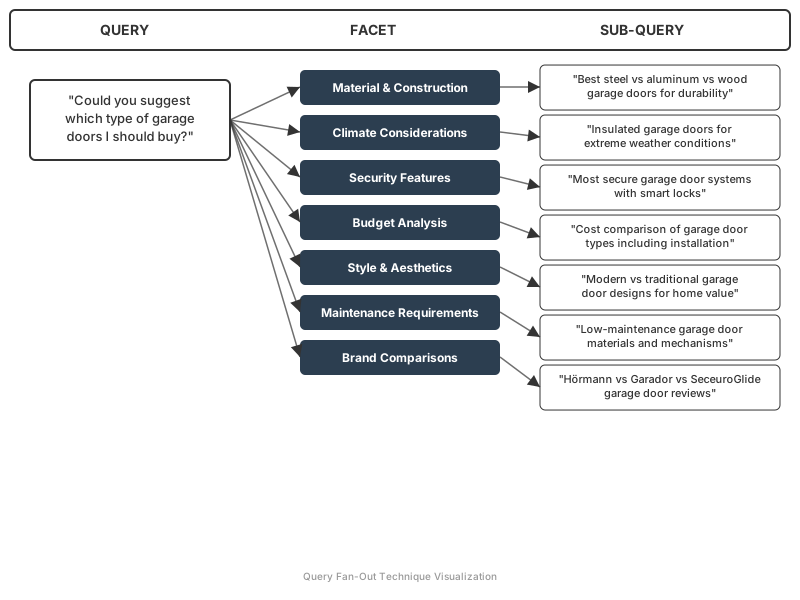
INITIAL QUERY: "Could you suggest which type of garage doors I should buy?"

FACET BREAKDOWN:
├── Material & Construction
│   └── "Best steel vs aluminum vs wood garage doors for durability"
├── Climate Considerations
│   └── "Insulated garage doors for extreme weather conditions"
├── Security Features
│   └── "Most secure garage door systems with smart locks"
├── Budget Analysis
│   └── "Cost comparison of garage door types including installation"
├── Style & Aesthetics
│   └── "Modern vs traditional garage door designs for home value"
├── Maintenance Requirements
│   └── "Low maintenance garage door materials and mechanisms"
└── Brand Comparisons
    └── "Hörmann vs Garador vs SeceuroGlide garage door reviews"
Strategic Implications for Content
This fan-out architecture creates new opportunities and challenges:
Content doesn't need to rank #1 to gain visibility. Unlike traditional search where position determines everything, fan-out mode pulls information from deeper results if the content quality and relevance warrant inclusion.
Semantic clarity trumps keyword density. AI prioritizes extractable, well-structured information over keyword-optimized content. Clear headings, logical flow, and comprehensive coverage matter more than exact-match phrases.
Authority remains paramount. While fan-out expands the content pool, it still favors established, trustworthy sources with strong E-E-A-T signals (Experience, Expertise, Authoritativeness, Trustworthiness).
Practical optimization strategies include:
- Structuring content with clear, extractable answers using descriptive subheadings
- Writing in natural, conversational language that mirrors user speech patterns
- Creating comprehensive topic coverage that anticipates related questions
- Building topical authority through depth rather than breadth
The Evolution from Keywords to Intent Architecture
AI Mode doesn't just change search results, it fundamentally transforms search behaviour itself. Users now ask complex, conversational, multi faceted questions, expecting nuanced, contextual responses. The AI interprets and reformulates these queries, often using entirely different language than the original search.
This behavioral shift renders traditional keyword research — focused on search volume and head terms — increasingly obsolete. Modern search strategy must pivot toward understanding intent patterns, user journeys, and contextual needs.
Critical Strategic Questions
What drives user queries at a fundamental level? Understanding motivations behind searches, not just the phrases used, becomes essential for content alignment.
Which query types trigger AI Mode engagement? AI Mode excels at queries requiring synthesis, comparison, or multi-perspective analysis — areas where traditional results feel fragmented.
How can brands position content as authoritative sources? Moving beyond generic answers to create comprehensive, reliable resources that AI systems can reference with confidence.
Which searches will continue driving website traffic? Lower funnel, transactional queries (purchasing, booking, contacting) still require website visits, maintaining their traffic value.
The Attribution Challenge
This creates a complex measurement problem: in attribution models still dominated by last-click analysis, brands may overvalue bottom-funnel performance while underestimating upper-funnel AI visibility that influences eventual conversions. Marketing teams must develop sophisticated multi-touch attribution models that account for zero-click influence.
The Quality Paradox
Expect a fundamental shift in traffic patterns:
- Lower overall volume as AI answers satisfy informational queries
- Higher conversion rates as remaining clicks come from highly motivated users
- Increased customer lifetime value from visitors who click through after AI validation
Content Strategy Recalibration: Evolution, Not Revolution
While AI Mode transforms search delivery, it doesn't require abandoning proven content principles. The fundamentals remain, but with evolved emphasis:
Core Principles (Unchanged)
- Prioritise E-E-A-T signals through genuine expertise and authority
- Create comprehensive, in depth content that fully addresses topics
- Focus on user value over search engine manipulation
Evolved Tactics (Adapted for AI)
- Answer first architecture: Structure content to directly address questions, not just target keywords
- Semantic organisation: Use clear headings, FAQ sections, and schema markup to enhance extractability
- Conversational tone: Write naturally, as AI systems better understand human speech patterns
- Comprehensive coverage: Anticipate related questions and provide complete topical exploration
Success metrics shift from ranking positions to inclusion frequency in AI responses, a fundamental change in how we evaluate content performance.
Strategic Implementation Roadmap
Marketing leaders should execute the following initiatives immediately:
Quarter 1: Foundation Setting
- Redefine KPIs and Reporting
- Implement impression and brand mention tracking
- Develop AI visibility dashboards
- Create zero-click value attribution models
- Conduct Comprehensive Behavior Audits
- Map user question patterns across platforms
- Identify high-value intent clusters
- Analyze competitor AI visibility
Quarter 2: Content Evolution
- Restructure Content Architecture
- Implement answer-first content frameworks
- Deploy comprehensive schema markup
- Create topical authority hubs
- Optimize for Extraction
- Rewrite key pages with semantic clarity
- Add FAQ sections and structured data
- Enhance content comprehensiveness
Quarter 3: Platform Expansion
- Multi Platform Presence
- Optimize for ChatGPT, Claude, and Perplexity
- Test content performance across AI systems
- Develop platform specific strategies
- Advanced Measurement
- Implement AI mention monitoring tools
- Create unified visibility reporting
- Develop predictive performance models
Conclusion: Embracing the Search Transformation
Google's AI Mode isn't simply a feature update, it's a fundamental redefinition of digital discovery. For marketing leaders, this moment demands strategic courage and operational agility. While core SEO principles endure, our definitions of success, measurement frameworks, and optimisation tactics must evolve dramatically.
Brands that embrace this transformation, building expertise centric content, adopting sophisticated measurement models, and optimising for multi platform discovery, will thrive in the AI powered future. Those clinging to traffic based metrics and traditional ranking strategies risk irrelevance in an ecosystem where influence transcends clicks.
The question isn't whether to adapt to AI-powered search, but how quickly you can transform your strategy to capture value in this new paradigm. The brands that move decisively now will define the standards for search success in the next decade.
References
- Google Search Blog: Introducing AI Mode in Search. Available at: https://blog.google/products/search/ai-mode-search/
- Google Search Central: AI Overviews and Your Website. Available at: https://developers.google.com/search/docs/appearance/ai-overviews
- Search Engine Land: Google AI Mode: What Marketers Need to Know. Available at: https://searchengineland.com/google-ai-mode-marketers-guide
- Moz: The Zero-Click Search Study. Available at: https://moz.com/blog/zero-click-searches
- Ahrefs: How to Optimize for AI Search Results. Available at: https://ahrefs.com/blog/ai-search-optimization/
- Google E-E-A-T Guidelines: Search Quality Evaluator Guidelines. Available at: https://developers.google.com/search/blog/2022/12/google-raters-guidelines-e-e-a-t
- Search Engine Journal: Query Fan-Out Explained. Available at: https://www.searchenginejournal.com/google-query-fanout/
- Perplexity AI: Understanding AI-Powered Search. Available at: https://blog.perplexity.ai/ai-powered-search
- ChatGPT: OpenAI's Approach to Search. Available at: https://openai.com/blog/chatgpt-search
- Claude: Anthropic's Search Integration. Available at: https://www.anthropic.com/claude-search
- Google Search Console: International Targeting Report. Available at: https://support.google.com/webmasters/answer/62399
- BrightEdge: AI Search Impact Study 2025. Available at: https://www.brightedge.com/research/ai-search-impact
If you found this article helpful, hit the thumbs up button
Ready to transform your search strategy for the AI era?
Contact Pure Rank Digital to develop a comprehensive AI Mode optimization strategy that positions your brand for success in the evolving search landscape.
Get Started Today