GEO Schema Metadata

How to Create GEO‑Friendly Metadata: A Practical, Evidence‑Based Guide
Pure Rank Digital Team 9 Aug, 2025 18 min read GEO Updated: 9 Aug, 2025
Vibrant GEO metadata hero: gradient map with pins, hreflang clusters, and schema nodes
GEO metadata concepts visualised: location pins, hreflang clusters, and schema connections

Search engines increasingly personalise and localise results. To surface for the right users in the right place, your pages must speak the language of location. This guide translates modern "geo signals" including structured data, hreflang, NAP consistency, map entities, and performance into a practical, auditable metadata system that scales across countries, regions, cities and service areas.

What “GEO‑Friendly Metadata” Means

GEO‑friendly metadata is the combination of on‑page and off‑page signals that unambiguously ties your content to a place and audience. At minimum: (1) correct geographic entities (country, region, city, coordinates), (2) language and market targeting, (3) consistent business identity (name, address, phone or NAP), and (4) machine‑readable structure (schema.org). When these agree, search engines can reliably index, de‑duplicate and rank the right landing page for the right user.

Core components

  • Language/market targeting: hreflang and region‑specific canonicals.
  • Entity definition: schema.org for places and businesses with persistent identifiers.
  • NAP consistency: matching name, address, phone and hours across site, GMB/GBP and citations.
  • Map discoverability: embedded, crawlable map links and coordinates.
  • Performance & accessibility: fast, mobile‑friendly, and accessible location pages.

Architecture at a Glance

The diagram below shows a recommended information architecture for multi‑region sites.
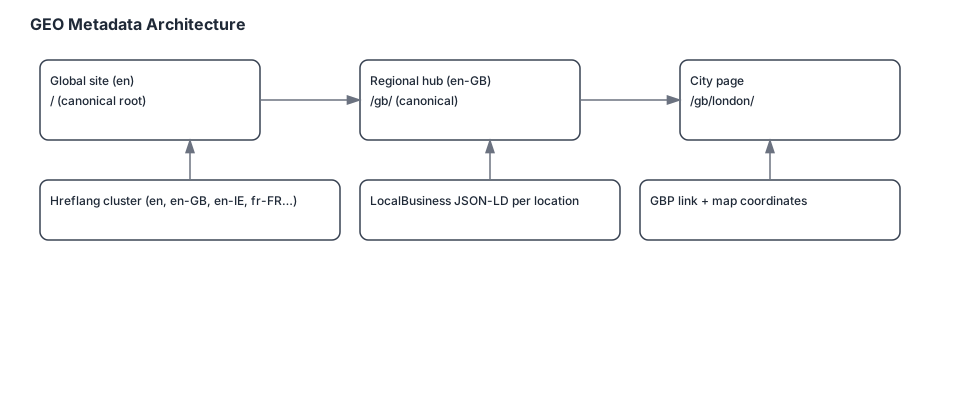
Infographic: GEO metadata flow—site pages, hreflang clusters, schema, maps

Checklist: Page‑Level GEO Metadata

ItemWhy it mattersExampleSource
Hreflang clusterPrevents wrong‑locale rankings; consolidates signals<link rel="alternate" hreflang="en-GB" href="https://example.com/gb/">Google Search Central
Canonical per marketDe‑dupes near‑identical regional pages<link rel="canonical" href="https://example.com/gb/">Google
LocalBusiness schemaMakes location & hours machine‑readableJSON‑LD snippet belowschema.org
Geo coordinatesDisambiguates places with identical namesgeo: { lat: 51.5074, lon: -0.1278 }schema.org
Clickable NAPBoosts mobile UX & conversions<a href="tel:+442071231234">+44 20 7123 1234</a>UX best practice
GBP linkTies the page to its Google Business ProfileLink to Place ID URLGoogle Maps

JSON-LD Template (LocalBusiness)

{
  "@context": "https://schema.org",
  "@type": "LocalBusiness",
  "@id": "https://example.com/gb/#store-london",
  "name": "Example Repairs London",
  "image": ["https://example.com/images/storefront.jpg"],
  "url": "https://example.com/gb/",
  "telephone": "+44 20 7123 1234",
  "priceRange": "££",
  "address": {
    "@type": "PostalAddress",
    "streetAddress": "221B Baker Street",
    "addressLocality": "London",
    "postalCode": "NW1 6XE",
    "addressRegion": "Greater London",
    "addressCountry": "GB"
  },
  "geo": {
    "@type": "GeoCoordinates",
    "latitude": 51.5237,
    "longitude": -0.1586
  },
  "openingHoursSpecification": [{
    "@type": "OpeningHoursSpecification",
    "dayOfWeek": ["Monday","Tuesday","Wednesday","Thursday","Friday"],
    "opens": "09:00",
    "closes": "18:00"
  }],
  "sameAs": [
    "https://maps.google.com/?cid=1234567890",
    "https://www.facebook.com/examplelondon"
  ]
}

Hreflang System That Scales

Create a single source of truth for languages and markets (a simple CSV works) and render hreflang clusters from it. Validate with Google Search Console’s International Targeting report and third‑party crawlers.
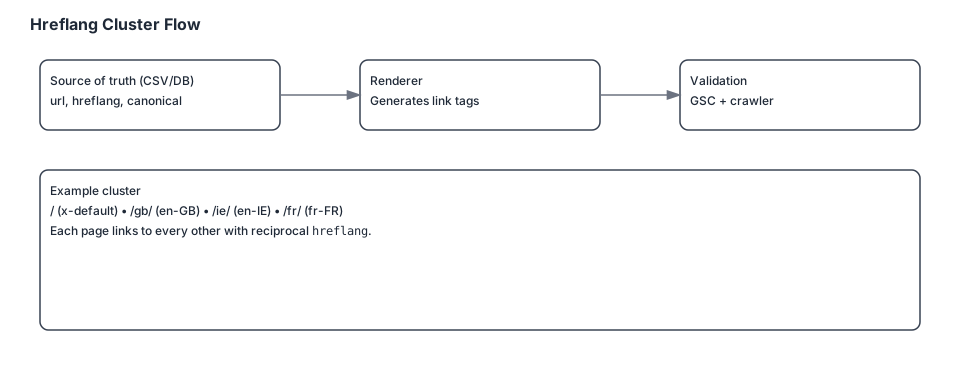
Diagram: hreflang cluster generation for multi-country sites

Common failure modes

  • Missing return tags across the cluster
  • Pointing hreflang at non‑canonical URLs
  • Using region codes without language (e.g., GB instead of en-GB)
  • Contradictory geo‑targeting in Search Console

Data‑Backed Priorities (with Sources)

The table below synthesises public research on local/geo ranking influence. Where studies differ, we state the range. Use this to prioritise sprints.

FactorEstimated impactNotesSource
Primary category matchHighCategory aligns with query intentWhitespark Local Search Ranking Factors
Proximity to searcherHighDistance heavily influences pack resultsMoz
On‑page signals (NAP, keywords, schema)Med‑HighCompleteness and consistency matterGoogle SEO Starter Guide
Reviews (count, velocity, sentiment)MediumParticularly for pack visibilityGoogle
Inbound links (quality, local relevance)MediumEntity corroborationAhrefs

Implementation Playbook by Scenario

Single‑location SMB

  1. Publish a dedicated location landing page with unique copy, embedded map, and LocalBusiness JSON‑LD.
  2. Ensure NAP matches GBP precisely; add click‑to‑call and structured opening hours.
  3. Optimise images (ALT text with city + service where natural), compress assets, and ensure Core Web Vitals pass.
  4. Build citations on authoritative local directories and industry verticals; aim for consistency, not volume.

Multi‑location brand

  1. Generate one location page per branch; avoid thin duplicates by adding staff, inventory, photos and reviews per city.
  2. Use a central data source (spreadsheet/DB) to output JSON‑LD and page content; re‑render nightly.
  3. Create per‑market hreflang clusters and regional canonicals.
  4. Assign a unique @id per location entity; keep them stable during redesigns.

International content (no physical locations)

  1. Use Organization + WebSite schema; focus on language/market with hreflang.
  2. Host region‑specific contact/tax/legal details where required.
  3. Translate by humans or high‑quality MT with review; avoid mixing languages on one URL.

QA & Monitoring

  • Crawl tests: programmatic checks that each location has valid JSON‑LD, map link, NAP, and appears in its hreflang cluster.
  • Indexing: Search Console Index Coverage + site: queries by city/service.
  • GBP parity: hours, categories and phone sync with website.
  • Web Vitals: field data on location pages.

Process & Governance

Create a simple operating model so GEO metadata doesn’t regress. Suggested RACI:

TaskResponsibleAccountableConsultedInformed
Location data accuracyOpsGMSEOSupport
Schema templatesSEOHead of GrowthEngineeringContent
Hreflang clustersEngineeringSEOLocal teamsAll

References

  1. Google Search Central: International & hreflang. Available at: https://developers.google.com/search/docs/specialty/international/localized-versions
  2. Google SEO Starter Guide: Available at: https://developers.google.com/search/docs/fundamentals/seo-starter-guide
  3. schema.org LocalBusiness: Available at: https://schema.org/LocalBusiness
  4. schema.org GeoCoordinates: Available at: https://schema.org/GeoCoordinates
  5. Google Business Profile: Reviews & guidelines. Available at: https://support.google.com/business/answer/3474122
  6. Whitespark: Local Search Ranking Factors. Available at: https://whitespark.ca/local-search-ranking-factors/
  7. Moz: Local Search Ranking Factors. Available at: https://moz.com/learn/local/local-search-ranking-factors
  8. Ahrefs: Local SEO guide. Available at: https://ahrefs.com/blog/local-seo/

If you found this article helpful, hit the thumbs up button

Ready to transform your search strategy for the AI era?

Contact Pure Rank Digital to develop a comprehensive AI Mode optimization strategy that positions your brand for success in the evolving search landscape.

Get Started Today

Enterprise Contact

Learn which plan is right for your team
Get onboarding help

Have other questions?

To better understand how we help our clients, please read client case studies

Feel free to reach out if you have any questions, Contact us

How long until SEO works and when will we see results? +

Short answer: most clients see meaningful, measurable growth in 3–6 months. You’ll usually notice early signals within 4–8 weeks (better indexation, rising impressions, small ranking lifts, more enquiries).

What affects the pace:

  • Your starting point (site health, content depth, backlinks, tracking).
  • Competition in your niche/locations.
  • How fast we can publish quality content and earn links.
  • Technical debt (crawl, speed, Core Web Vitals, UX).
  • Budget and scope.

What the first 6 months look like:

  • Weeks 1–4: Full audit, fix critical technical issues, tracking set-up, quick wins, on-page clean-up, internal linking, schema.
  • Months 2–3: New content goes live, local signals/citations strengthen, authority building starts; rankings and impressions begin to move.
  • Months 3–6: Compounding gains—more page-one entries, steady traffic uplift, and most businesses start to feel the lead/revenue impact.

Disclaimer:

  • No one can guarantee page-one by a date. If they do, walk away.
  • Brand-new domains or highly competitive markets can take longer. Core updates can nudge timelines.

What we commit to:

  • A clear roadmap with weekly/fortnightly updates.
  • Transparent reporting in GA4, GSC and Looker Studio (not vanity metrics).
  • Quality content, safe link acquisition, and ongoing technical optimisation—no gimmicks.

Bottom line: SEO isn’t instant, but if we execute properly, 3–6 months is a realistic window to see meaningful results, with momentum building from there.

Do you lock clients into long-term contracts? +

No. We ask for a 6-month commitment, then it’s rolling month-to-month with 30-day notice. No auto-renewals. No exit fees.

Why 6 months? That’s the minimum to audit, fix technical issues, implement the required amount of content, build authority, and prove ROI. After that, we keep you by results, not contracts.

This is the best arrangement you’ll find in the market and it reflects our confidence in the process. If we’re not delivering, you’re free to walk. Simple.

Is SEO still worth it in 2025? +

Yes if you treat it as Search + Answer + Brand. People still start with Google, but the results page now includes Google AI Overviews and Google’s AI Mode. On top of that, your customers are asking ChatGPT, Gemini and Perplexity “who’s the best near me?” If you’re not optimised for these answer engines, you’re invisible where decisions are being made.

What changed

  • AI Overviews/AI Mode summarise an answer and cite sources. If you’re not a cited source, you’re not in the consideration set.
  • LLMs recommend brands based on authority, consistency and corroboration across the web, not just on-page keywords.

What works now (our approach)

  • AEO/GEO (Answer/Generative Engine Optimisation): We engineer pages to be citable with clear answers above the fold, verified stats, original assets, and tight information architecture that LLMs can lift from confidently.
  • Entity & brand building: We strengthen your brand entity so Google and LLMs can recognise and choose you, consistent NAP (Name, Address, Phone), author E-E-A-T, citations, reviews, PR and high-authority mentions.
  • Structured data done properly: Full schema coverage (Organisation, Services, FAQs, HowTo, Product, Reviews) to feed AI Overviews and knowledge graphs.
  • Content that wins snippets & summaries: Concise Q&A sections, comparisons, pricing pages, location/service pages that are formatted for extraction.
  • Technical SEO that still matters: Crawlability, speed/Core Web Vitals, self-referencing canonical tags, log-file driven internal linking... LLMs still read the same web.
  • Measurement beyond “sessions”: We track AI Overview citations, LLM recall/share of voice, brand mention velocity, zero-click impact, leads and revenue—not vanity rankings.

So… is it worth it?

If you only chase blue links, no. If you optimise for Google + AI Overviews + AI Mode + LLM pickers, absolutely. Organic still compounds and unlike ads, you’re not renting visibility.

Our commitment

  • 6-month commitment, then 30-day rolling (no handcuffs).
  • A clear roadmap focused on getting you cited and selected by Google’s AI surfaces and leading LLMs.
  • Transparent reporting tied to pipeline and revenue.

Bottom line: SEO in 2025 is about being the source AI trusts and the brand AI recommends. That’s what we build.

Can you help with Local SEO? +

Yes. We run Local SEO like a data project, not guesswork.

How we do it

  • Mine your data first: We pull query intelligence from your Google Business Profile (GBP) and historic Google Search Console data (by location). This shows exactly which location-based searches you’re appearing for...and which you’re missing. We use this to map gaps and prioritise what to publish next.
  • Build the right local assets:
    • Unique location + service pages (no doorway fluff): clear offer, proof, map, FAQs, CTAs.
    • GBP optimisation: correct primary/secondary categories, Services, Attributes, Products, Photos, Posts, Q&A.
    • Schema: LocalBusiness, Service, FAQ, GeoCoordinates; UTM-tagged GBP links for clean attribution.
  • Trust & authority: Consistent NAP, citation clean-up/build, review acquisition programme (with response playbooks), and local link wins (partners, sponsorships, press).
  • Technical & UX: Fast pages, mobile-first, internal linking to surface local relevance; strong conversion UX (click-to-call, directions, booking).
  • Measurement that matters: Map Pack/share-of-voice, geo-split GSC performance, calls, direction requests and enquiries reported monthly.

Bottom line: We gather query info from your Google Business Profile and past Google Search Console data to identify missing location content and then implement it; properly structured, locally credible, and measurable. Works for single-location and multi-location brands.

Who implements changes? Do you handle dev/CMS? +

Short answer: We do, end to end. If you’ve got an in-house developer or team, we’ll happily work through them. Either way, we insist on full, transparent comms.

How we work

  • Default (we implement): We implement changes straight to your site along with technical fixes, content updates, schema, internal linking and speed/Core Web Vitals. Staging → QA → deploy, with rollback covered.
  • With your dev team: We switch to “spec & support” mode, Jira/Linear-ready tickets, acceptance criteria, code snippets/PRs, and reviews. We’ll align to your process and release periods.
  • CMS/stack coverage: WordPress (Gutenberg/Elementor), Shopify, Webflow, and headless stacks (e.g. Next.js). For custom builds, we contribute PRs or supply components/templates.
  • Access & governance: Least-privilege access, backups, staging-first releases, GTM workspace/approvals, and a clear changelog you can audit.
  • Transparency: One shared channel, clear roadmap, what’s in flight, what’s implemented and the impact.

Bottom line: We handle implementation unless you prefer your devs to. We’re effective both ways, provided we can collaborate directly with your team, keeping you in the loop at all times.

Can you help after a core update or penalty? +

Yes. We’ve worked with clients who came to us under a Google penalty and we’ve addressed the issues and successfully appealed until the penalty was removed. For core update hits, we’ve led full recoveries by fixing the underlying site and content issues. That said, recovery depends on severity and how long the problem has existed. No fairy dust.

What we actually do

  • Triage: Confirm if it’s a manual action (in GSC) or algorithmic impact from a core update.
  • Forensics: Directory/template-level diffing of winners vs losers, log-file and crawl analysis, indexation/canonical checks, internal linking, CWV, entity/intent alignment, content quality (E-E-A-T), and link risk.
  • Remediation plan:
    • Technical: crawl/indexation hygiene, canonical fixes, Core Web Vitals, rendering.
    • Content: consolidate thin/duplicative pages, add original evidence, pricing/process/FAQs, author creds, citations, and schema.
    • Architecture: tighter internal linking and topic clustering.
    • Links: remove/neutralise manipulative links where possible; disavow only when justified.
  • Manual actions: Prepare evidence pack and submit reconsideration requests, iterating until resolved.
  • Monitoring: Track recovery with GSC/GA4, query sets, directories, and templates (not vanity charts).

Disclaimer

  • Manual penalties: Often fixable with proper clean-up and strong documentation; timelines vary.
  • Core updates: Improvements can lift you sooner, but full recovery often aligns with subsequent updates.
  • Limits: Long-standing or severe violations, heavy link schemes, or years of thin content take longer and may not fully rebound.

Bottom line: We’ve removed penalties and reversed core-update losses before. We’ll tell you, upfront, what’s realistic and then do the hard work to get you back.

How do you communicate and how often? +

Channels:

WhatsApp, Slack, Teams, phone, video calls, and face-to-face messages. We’ll use what your team already lives in.

Cadence (straight talk):

  • Intense periods (troubleshooting / launches / incidents): as frequent as up to 10 touchpoints per day across chat/calls—whatever it takes to resolve fast.
  • Steady state: at least once a week. Typically a weekly update (results, what shipped, what’s next) plus a quick call if needed.

How we run comms:

  • One shared channel (Slack/Teams) for transparency and speed.
  • WhatsApp for urgent decisions.
  • Scheduled video/phone check-ins (weekly or fortnightly).
  • Clear action logs and a visible changelog so nothing gets lost.

Bottom line: We’re easy to reach, we communicate like adults, and the frequency flexes with the work, from 10x/day when needed to a light weekly touchpoints when things are going as expected.