AI-Powered SEO: The 2025 Landscape
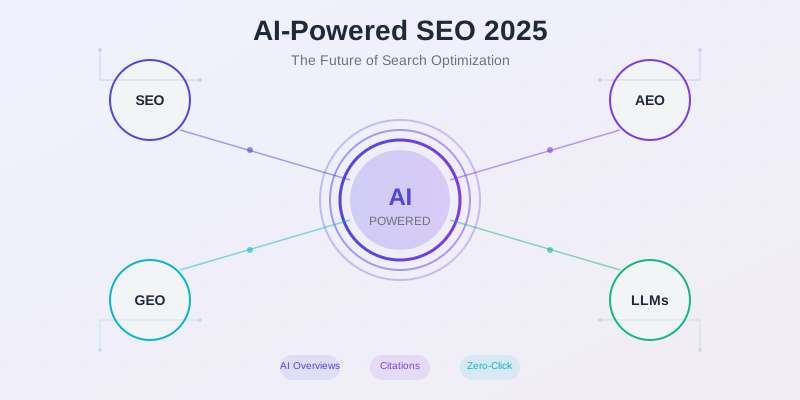
The SEO landscape has undergone a seismic shift. With AI Overviews appearing in searches, traffic patterns changing dramatically, and new optimization strategies like AEO and GEO emerging, the traditional playbook is being rewritten. This comprehensive guide explores what's working in 2025's AI-powered search ecosystem and provides actionable strategies to maintain and grow your visibility.
Executive Summary: The AI Revolution in Search
Key Findings at a Glance
- • AI Overviews now appear in ~1.28% of searches, down from initial rollout but still impactful
- • Traffic declines average 3-9% for sites featured in or excluded from AI Overviews
- • 40% of searches result in zero clicks, fundamentally changing user behavior
- • New strategies (AEO & GEO) are emerging to optimize for AI-driven search
- • 70% volatility in AI Overview citations over 2-3 month periods
Part 1: AI Overviews: Still Here, But Evolving
Introduced in mid-2023 as part of Google's Search Generative Experience and fully rolled out globally by late 2024, AI Overviews have become a permanent fixture in the search landscape. However, their implementation and impact have evolved significantly from initial predictions.
Current State of AI Overviews
AI Overview Statistics (2025)
Despite initial accuracy issues that plagued the rollout, Google maintains that overall click volumes remain stable. They emphasize that high-quality content and original formats continue to perform well, even within the AI Overview ecosystem.
What Triggers AI Overviews
- Informational queries: Questions seeking factual information or explanations
- How-to searches: Step-by-step processes and tutorials
- Comparison queries: "X vs Y" or "best" type searches
- Definition searches: "What is" queries and technical terms
- Health & medical queries: Symptoms, treatments, and medical information (with disclaimers)
Part 2: Traffic Impacts & Publisher Concerns
The introduction of AI Overviews has created significant disruption in traditional traffic patterns, with publishers experiencing varied impacts based on their content strategy and niche.
The Traffic Reality Check
Traffic Impact Breakdown
- • Sites featured in AI Overviews: Average 9% traffic reduction
- • Sites not featured: Average 3% traffic reduction
- • Zero-click searches: Now account for 40% of all queries
- • Mobile impact: 50% higher on mobile devices
A Wall Street Journal study has revealed that approximately 40% of searches now result in no clicks at all, fundamentally changing how brands must approach visibility and engagement strategies.
Publisher Response and Concerns
Cloudflare's CEO has issued warnings about existential threats to the traditional web model, urging AI companies to compensate creators fairly for the content being used to generate these overviews. This has sparked industry-wide discussions about:
- Content licensing: Negotiations for fair compensation models
- Attribution standards: Ensuring proper credit for source material
- Traffic alternatives: Building direct audience relationships
- Revenue diversification: Moving beyond ad-dependent models
Part 3: Rise of New Strategies - AEO & GEO
As traditional SEO evolves to meet AI challenges, two new optimization paradigms have emerged as essential strategies for maintaining visibility in the AI-driven search ecosystem.
Answer Engine Optimization (AEO)
What is AEO?
Answer Engine Optimization focuses on crafting content that conversational AI systems (ChatGPT, Gemini, Claude, Perplexity) are likely to cite in direct answers. Rather than chasing traditional keywords, AEO leverages clusters of questions and conversational patterns.
Core AEO Principles:
- • Question clustering: Group related questions and provide comprehensive answers
- • Conversational structure: Write in natural, dialogue-friendly formats
- • Direct answers first: Lead with clear, concise responses
- • Evidence-based content: Include citations and authoritative sources
- • Multi-perspective coverage: Address different viewpoints and edge cases
Generative Engine Optimization (GEO)
What is GEO?
Generative Engine Optimization involves structuring content to be machine-readable through metadata, structured cues, and specialized files like llms.txt. It's about making your content easily parseable and contextually rich for AI systems.
GEO Technical Components:
- • Structured data markup: Enhanced schema.org implementation
- • llms.txt files: Machine-readable site instructions
- • Semantic HTML: Proper heading hierarchies and semantic tags
- • Entity disambiguation: Clear entity relationships and definitions
- • API-ready content: JSON-LD and microformats
AEO vs GEO vs Traditional SEO
| Aspect | Traditional SEO | AEO | GEO |
|---|---|---|---|
| Primary Focus | Keywords & rankings | Direct answers | Machine readability |
| Content Structure | Long-form articles | Q&A clusters | Structured data |
| Optimization Target | Google algorithm | AI chatbots | LLM parsers |
| Success Metrics | Rankings, traffic | Citations, mentions | AI visibility |
| Technical Priority | Page speed, mobile | Content clarity | Metadata, APIs |
Part 4: Trends & Tactical Approaches for AI-Driven SEO
Reddit discussions and industry research have revealed several emerging best practices that are proving effective in the new AI-dominated landscape.
Entity-First Indexing & Structured Formatting
Why Entity-First Matters
SEO now prioritizes entity recognition over keyword density. AI systems understand concepts, not just strings of text. Your content must establish clear entity relationships and topical authority.
Implementation Tactics:
- • Build comprehensive topic clusters around core entities
- • Use Knowledge Graph-friendly markup
- • Create entity-based internal linking structures
- • Develop "about" pages for key concepts
- • Implement co-occurrence patterns for related entities
Volatile Rankings Management
With approximately 70% of AI Overview citations shifting over 2-3 month periods, traditional ranking stability is a thing of the past. Success requires adaptive strategies:
- Weekly monitoring: Track AI Overview appearances and citation changes
- Content freshness: Regular updates to maintain relevance
- Multiple format coverage: Same content in various formats (text, video, infographics)
- Citation diversity: Aim for mentions across multiple AI systems
Video & Visual Content Dominance
Visual Content in AI Overviews
AI Overviews increasingly favor visual assets, particularly video tutorials and demonstrations. Visual content sees 2.3x higher inclusion rates.
High-Performance Formats:
- • How-to videos (3-5 minutes)
- • Process infographics
- • Comparison charts
- • Interactive demos
- • Step-by-step galleries
Optimization Requirements:
- • Detailed video transcripts
- • Chapter markers
- • Alt text for all images
- • Structured data markup
- • Mobile-optimized players
E-E-A-T in the AI Era
Experience, Expertise, Authoritativeness, and Trustworthiness (E-E-A-T) remain critical, but implementation has evolved:
Modern E-E-A-T Signals
| Experience: | First-hand accounts, case studies, original research, user testimonials |
| Expertise: | Author credentials, certifications, detailed bios, contributor pages |
| Authoritativeness: | Citations from reputable sources, industry recognition, backlink quality |
| Trustworthiness: | Transparent methodology, source citations, fact-checking, update history |
Fresh, High-Quality Content Strategies
- Long-tail query optimization: Target specific, conversational queries that AI systems answer
- Content velocity: Publish consistently to maintain freshness signals
- Update cadence: Refresh existing content every 60-90 days
- Schema markup: Implement comprehensive structured data for all content types
- FAQ sections: Add question-based content to every major page
Part 5: Tooling & Platform Response
The SEO industry has rapidly developed new tools and platforms to help marketers navigate the AI-driven search landscape.
New AI Visibility Tools
Wix AI Visibility Overview
Wix has launched a comprehensive AI Visibility Overview tool that helps sites:
- • Monitor mentions within AI platforms
- • Track citation frequency across chatbots
- • Benchmark performance against competitors
- • Identify optimization opportunities
SEMrush AI Overview Tracking
SEMrush now provides AI-specific metrics including:
- • AI Overview presence by domain
- • Query-level AI visibility data
- • Citation source analysis
- • Competitive AI gap analysis
Essential Tools for AI-Powered SEO
| Tool Category | Purpose | Key Features |
|---|---|---|
| AI Visibility Monitors | Track AI citations | Real-time alerts, multi-platform tracking |
| Schema Generators | Create structured data | AI-optimized markup, validation tools |
| Content Optimizers | AEO/GEO optimization | Question clustering, entity analysis |
| Performance Trackers | Monitor traffic impact | Zero-click analysis, attribution modeling |
Comprehensive Strategy Summary
AI-Powered SEO Strategy Framework
Foundation (Weeks 1-4)
- ✓ Audit current AI visibility
- ✓ Implement structured data
- ✓ Create llms.txt file
- ✓ Optimize E-E-A-T signals
- ✓ Set up monitoring tools
Optimization (Weeks 5-8)
- ✓ Develop AEO content clusters
- ✓ Create video content
- ✓ Build entity relationships
- ✓ Implement GEO markup
- ✓ Launch FAQ sections
Scaling (Weeks 9-12)
- ✓ Expand content formats
- ✓ Cross-platform optimization
- ✓ Build topical authority
- ✓ Enhance user signals
- ✓ Diversify traffic sources
Maintenance (Ongoing)
- ✓ Weekly citation monitoring
- ✓ 60-90 day content updates
- ✓ Competitive gap analysis
- ✓ Algorithm change adaptation
- ✓ Performance optimization
Quick Reference: Strategy Comparison Table
| Strategy/Tool | What It Does | Implementation Priority |
|---|---|---|
| AI Overviews | Concise summaries from Google; click behavior is shifting | Monitor & Adapt |
| AEO (Answer Engine Opt.) | Tailors content to be cited by AI chatbots | High Priority |
| GEO (Generative Engine Opt.) | Uses structured data/meta to appeal to LLMs | High Priority |
| Content Best Practices | E-E-A-T, long-tail, multimedia, schema markup | Essential |
| Tools (Wix, SEMrush, etc.) | Track AI visibility and overview presence | Implement ASAP |
Conclusion: Navigating the New Search Reality
The AI revolution in search is not coming; it's here. With 40% of searches resulting in zero clicks and AI Overviews fundamentally changing how users interact with search results, the traditional SEO playbook needs a complete rewrite.
Success in 2025's search landscape requires a multi-faceted approach that combines traditional SEO fundamentals with new strategies like AEO and GEO. Organizations that adapt quickly, embrace entity-first thinking, and prioritize machine-readable content will thrive in this new ecosystem.
Key Takeaways for Success
- • Accept the new reality: Traffic patterns have permanently changed
- • Diversify your strategy: Combine SEO, AEO, and GEO approaches
- • Focus on quality: E-E-A-T matters more than ever
- • Embrace multimedia: Video and visual content dominate AI selections
- • Monitor constantly: AI citations are volatile and require active management
- • Build direct relationships: Don't rely solely on search traffic
The organizations that will win in this new landscape are those that view AI not as a threat to be feared, but as an opportunity to provide even better, more accessible content to users. The future of search is conversational, intelligent, and user-centric; and the time to adapt is now.
References
- Google Search Central: AI Overviews and structured data. Available at: https://developers.google.com/search/docs/appearance/ai-overviews
- Search Engine Land: Zero-click searches hit 65% in 2024. Available at: https://searchengineland.com/zero-click-searches-2024-statistics
- Moz: The Complete Guide to E-E-A-T. Available at: https://moz.com/learn/seo/eat
- Ahrefs: Answer Engine Optimization (AEO) Guide. Available at: https://ahrefs.com/blog/answer-engine-optimization/
- BrightEdge: Generative Engine Optimization Research. Available at: https://www.brightedge.com/resources/research/generative-engine-optimization
- SEMrush: AI Overviews Tracking and Analysis. Available at: https://www.semrush.com/blog/ai-overviews-seo/
- Wix SEO Hub: SEO in the Age of AI. Available at: https://www.wix.com/seo/learn/ai-seo
- Perplexity: Building for Answer Engines. Available at: https://blog.perplexity.ai/building-for-answer-engines
- Claude (Anthropic): Best Practices for AI Citations. Available at: https://www.anthropic.com/claude/citations
- OpenAI: ChatGPT Search and Web Citations. Available at: https://openai.com/blog/chatgpt-search
- Schema.org: Structured Data Documentation. Available at: https://schema.org/docs/gs.html
- YouTube Creator Hub: Video SEO Best Practices. Available at: https://www.youtube.com/creators/how-things-work/discovery/
If you found this article helpful, hit the thumbs up button
Ready to transform your search strategy for the AI era?
Contact Pure Rank Digital to develop a comprehensive AI Mode optimization strategy that positions your brand for success in the evolving search landscape.
Get Started Today